Key Concepts
Trade-off: the act of making a decision between alternatives
Opportunity cost: the value of what you gave up when making that decision
https://fs.blog/tradeoffs-decision-making/
If you’re young, you think you can go all out in your career, have fulfilling relationships, travel on a regular basis, keep up with reading and social media, go without sleep, take out unnecessary credit card debt, and start a family at the same time. The end result is always a total meltdown.“ The truth is, when you’re trying to get everything right, you’re getting nothing right.
But often the tradeoffs are genuinely hard to evaluate—people with world-class math abilities are often socially clueless, and many parents sacrifice career advancement to raise their kids. We all have to make sacrifices to be able to invest in what is important to us. Tradeoffs imply that to get really great at a few things, you have to accept being mediocre at a lot more.
How to take tradeoffs into account
One of the most important areas where we need to pay attention to tradeoffs is when we make decisions. It’s not always enough to consider what we stand to gain from going for option B over option A. We also need to take into account what we lose.
For instance, understanding tradeoffs in time usage is a good way to cut out unwanted, unhelpful behaviors and wastage.
We’d all agree that we’d rather devote our time to activities we value, yet we can end up not acting that way out of habit or obligation or simply because we haven’t considered what we’re forgoing.
The final requirement in order to take tradeoffs into account is that you really need to be able to let go of not being great at something. If you’ve chosen to prioritize your relationship with your kids over a clean house, then you need to be okay with letting other people see the mess. If you’ve prioritized physical activity over entertainment, you need to accept that other people are going to tease you for being ignorant of what’s going on in the world. If you’ve chosen to focus on your career versus maintaining every friendship you’ve ever had, you need to get over the pang of hurt when people stop inviting you out.
omg This hits me.
Reflections
“If you’re trying to get everything right, you’re getting nothing right.”
-
I really felt this. I learned it by myself and from books or the internet.
-
I used to think I could learn boxing, hiking, French cuisine, find a girlfriend, spend more time with friends, travel, learn machine learning… all at once.
-
But what I actually do now: learn R for data science, study finance, read books, cook, learn French, go to the gym sometimes.
-
I know I can’t do everything well. I wrote my goals and daily routine, but still — there’s too much.
-
I spend 30 minutes on French. Clearly, I can’t become advanced that way.
-
I spend 30 minutes at the gym. Clearly, I can’t have a perfect body.
-
-
I know this, but I haven’t fully accepted it emotionally. I’m still learning to embrace the idea that I can only get really great at a few things.
What I’ve Learned
-
Really accept that getting great at a few things means being mediocre at many others. I used to think I had to do well in everything — maybe it’s cultural or societal — but it’s impossible.
-
Value my time. Social media is mostly harmful.
-
Focus on what I value most right now: coding and finance(basically learning). Still keep some time for health and relationships, but not too much.
https://www.stlouisfed.org/open-vault/2020/january/real-life-examples-opportunity-cost
The Scoop on Scarcity
We can’t have everything we want in life. This is where scarcity factors in. Our unlimited wants are confronted by a limited supply of goods, services, time, money and opportunities. This concept is what drives choices—and, by extension, costs and trade-offs
Costs That Are Seen and Unseen
That’s why Caceres-Santamaria challenges us to consider not only explicit alternatives—the choices and costs present at the time of decision-making—but also implicit alternatives, which are “unseen” opportunity costs.
What are some other examples of opportunity cost?
A student spends three hours and $20 at the movies the night before an exam. The opportunity cost is time spent studying and that money to spend on something else.
A farmer chooses to plant wheat; the opportunity cost is planting a different crop, or an alternate use of the resources (land and farm equipment).
A commuter takes the train to work instead of driving. It takes 70 minutes on the train, while driving takes 40 minutes. The opportunity cost is an hour spent elsewhere each day.
Using the car-buying example, a consumer might default to thinking of the relative value of the 18,500.
Rather than comparing the fancier configuration to the vehicle itself, it might be more helpful to ask what else that $1,500 could buy outright.
like the examples here. The opportunity cost is not just the money, but also the time. That time and money could be used for other productive things.
I especially like the car example. When we buy expensive things, we often feel a natural impulse to go for the “slightly more expensive” upgrade or accessory — it feels cheap relative to the base price. But from another angle, we should ask: what else could we do with that upgrade money itself? That same amount could be spent on something entirely different and possibly more valuable.
Production Possibilities Curve
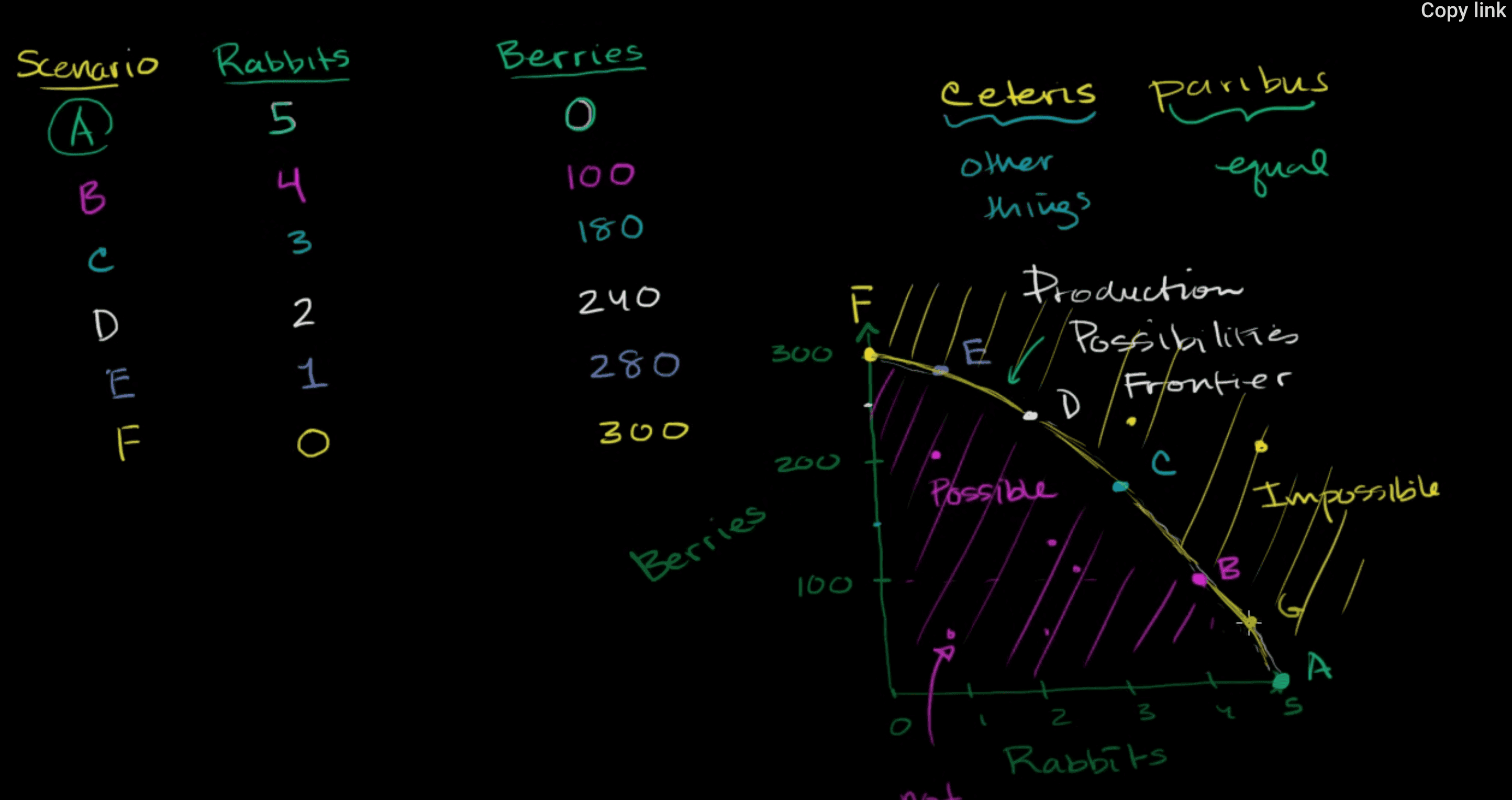
It is really straightforword to watch this example, The A-F scenarios show the possibilities about how many rabbits and berries can be collected, and then a curve. The left side can be possible, you can sometimes be lazy not collect so much rabbits or berries, the right side is impossible.
Opportunity cost
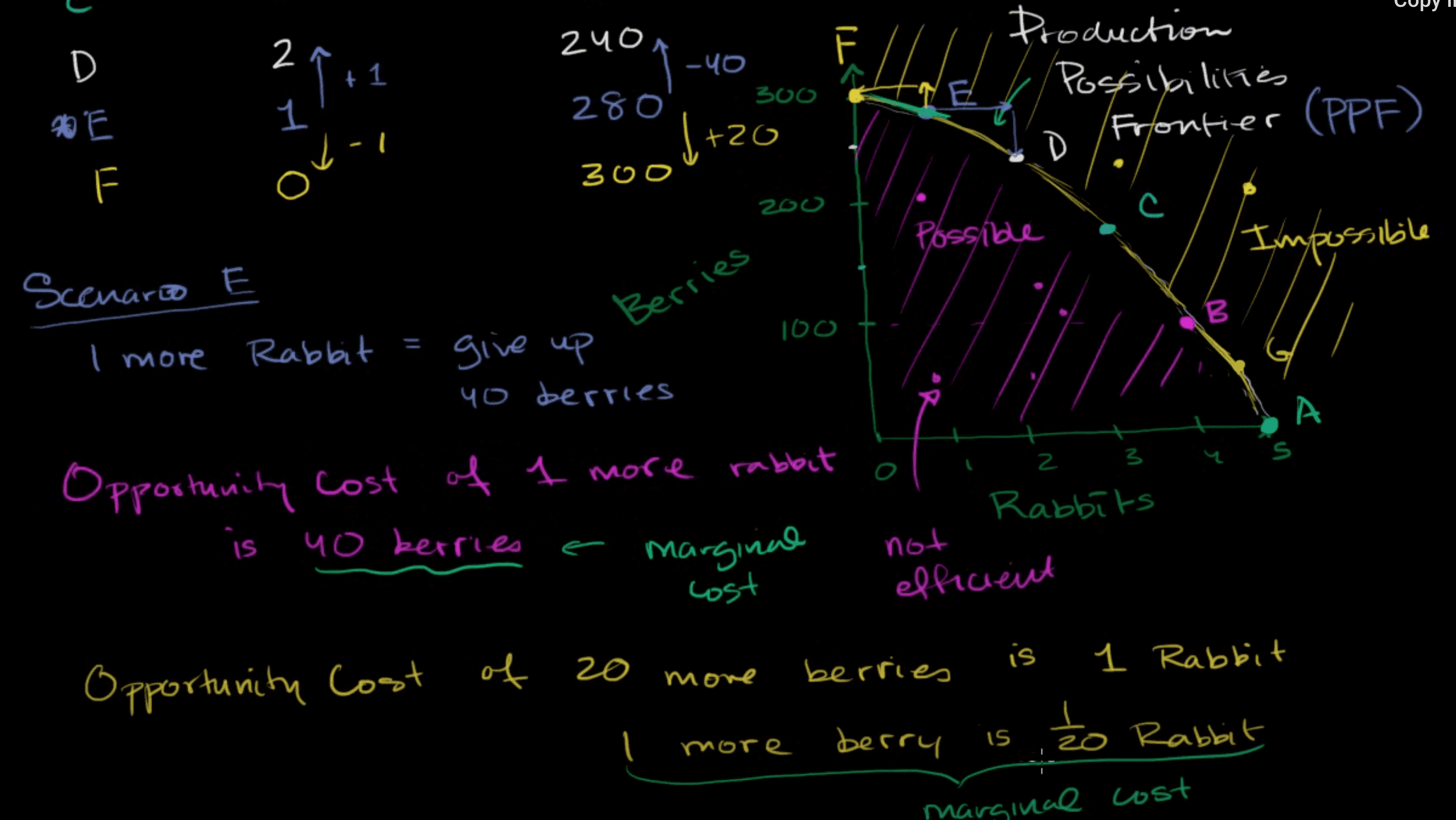
Increasing opportunity cost
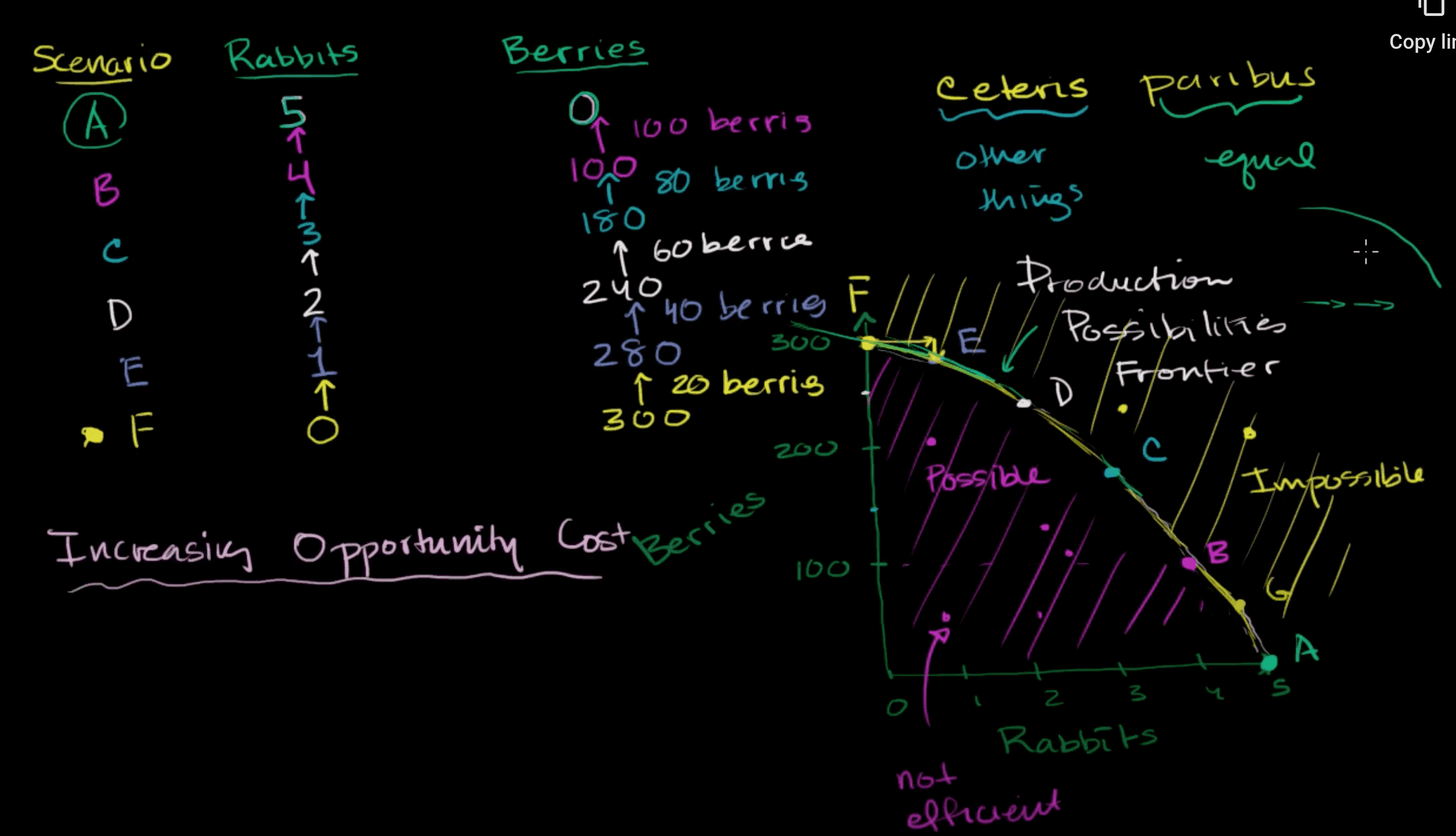
As you can see, when F - A, the opportunity cost increases and the slope more and more negative. like the bowed shape.
PPCs for increasing, decreasing and constant opportunity cost
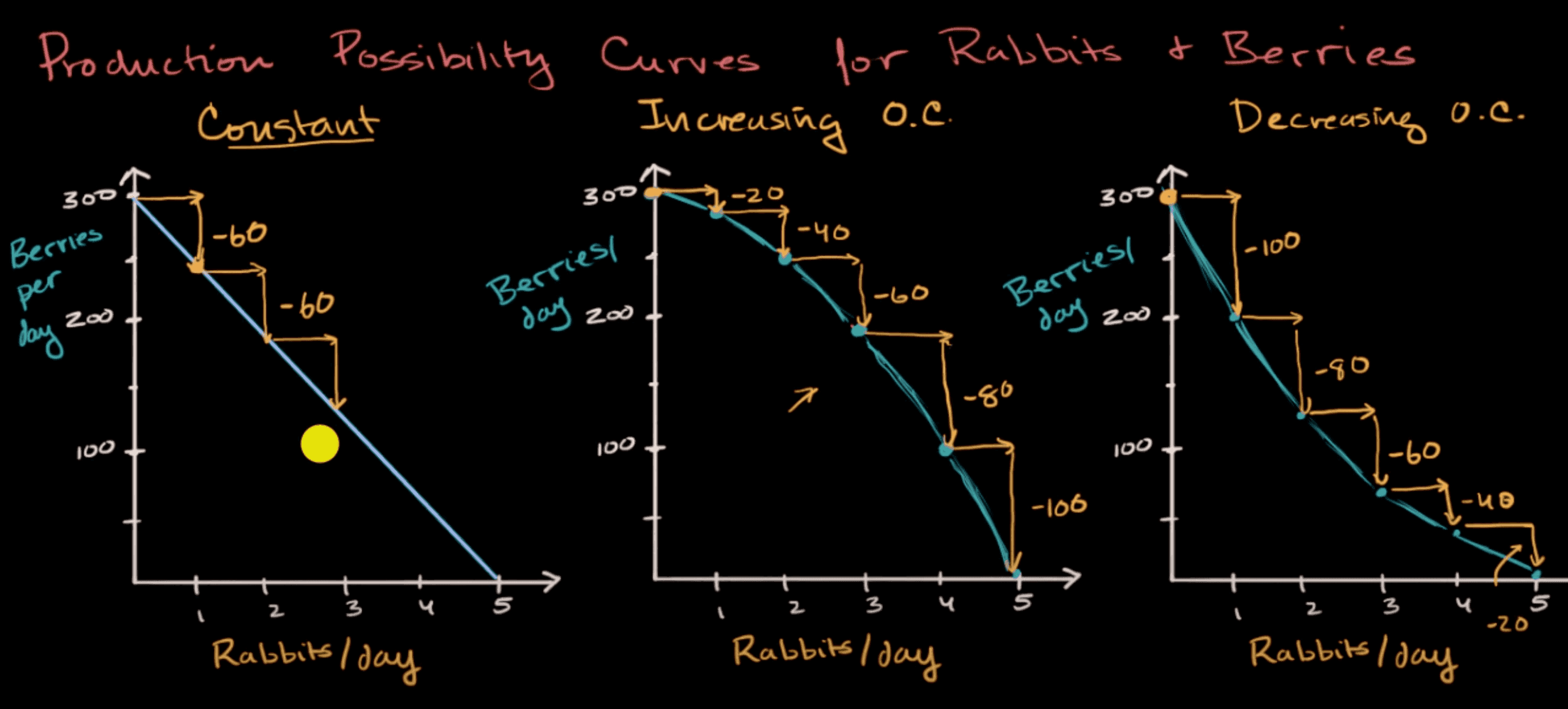
I like the way to show one unit increase in rabbit, and the draw the line to illustrate how many berries will be decreased, then you can clearly see whether it’s increasing opportunity cost or decreasing opportunity cost.
Production Possibilities Curve as a model of a country’s economy
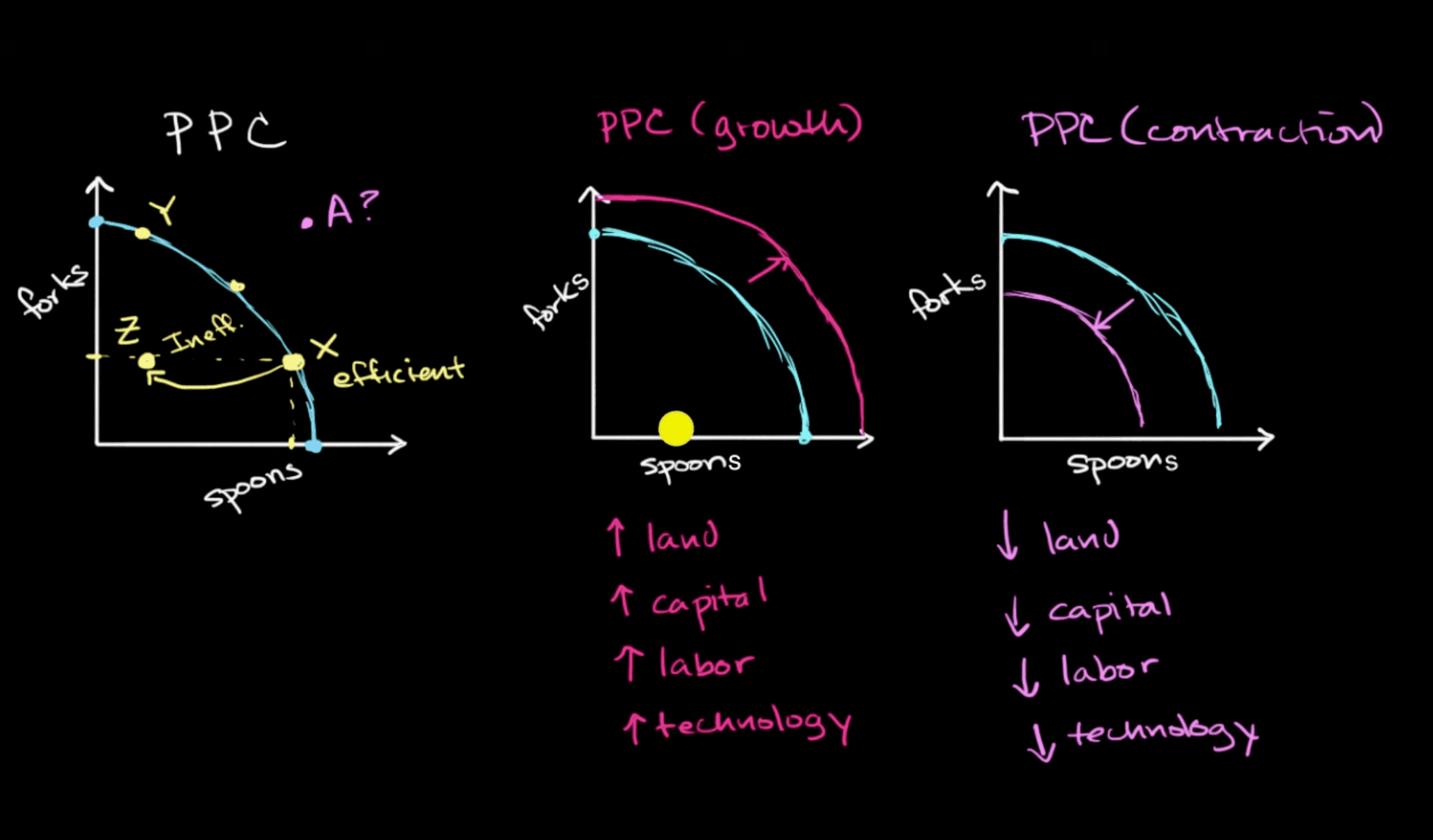
Y X - efficient usage of resources Z - Inefficiency A - impossible unless we have more growth in lands tech etc.
Lesson summary: Opportunity cost and the PPC
The Production Possibilities Curve (PPC) is a model used to show the tradeoffs associated with allocating resources between the production of two goods. The PPC can be used to illustrate the concepts of scarcity, opportunity cost, efficiency, inefficiency, economic growth, and contractions.
For example, suppose Carmen splits her time as a carpenter between making tables and building bookshelves. The PPC would show the maximum amount of either tables or bookshelves she could build given her current resources. The shape of the PPC would indicate whether she had increasing or constant opportunity costs.
The PPC isn’t just about drawing curves — it’s about training my brain to think:
“Given limited resources, what trade-off am I really making — and is it the smartest one?”